Morgan Neumann · 28 October 2026
Board Games Bring Hester Prynne's Ethical Dilemmas to Life for Educational Play
Educators have incorporated board games into literature curricula to let students navigate the moral conflicts that define Hester Prynne's story in Nathaniel Hawthorne's The Scarlet Letter, and these games translate the novel's 17th-century setting into interactive mechanics that require players to weigh personal integrity against communal pressure. Research from the National Council of Teachers of English indicates that such activities increase engagement with classic texts while reinforcing skills in ethical reasoning and textual analysis.
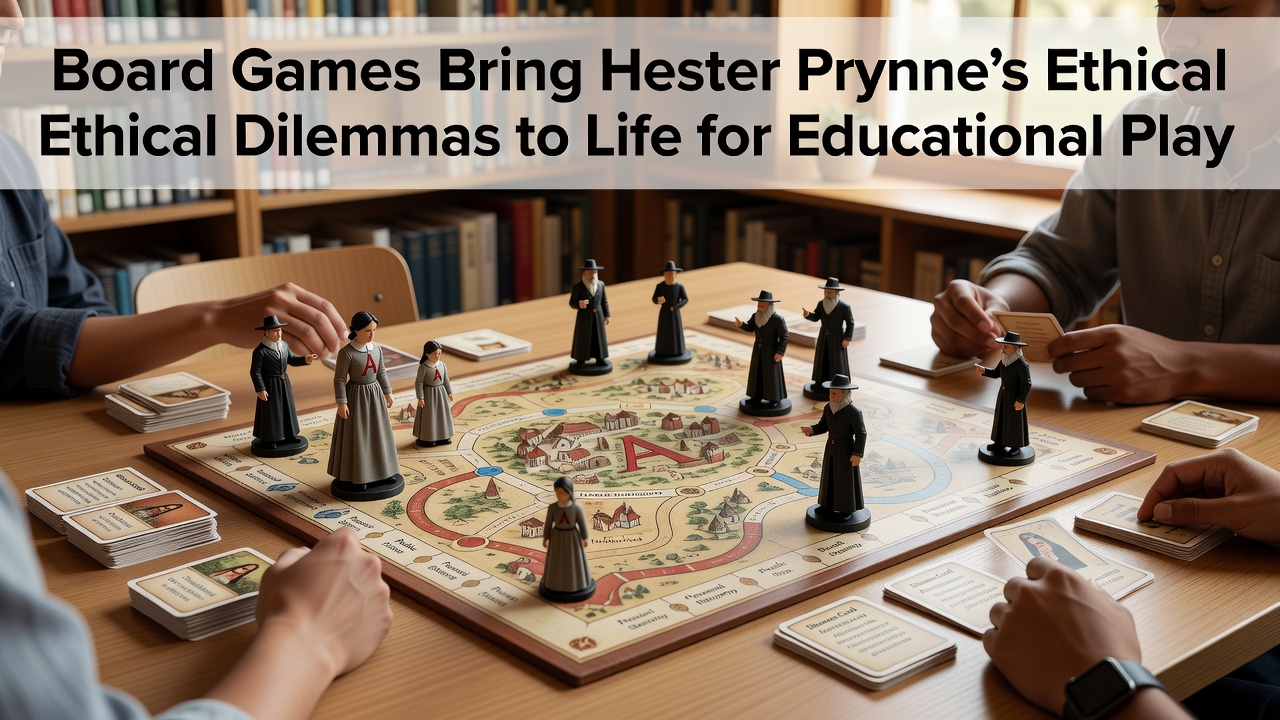
Game designers adapt Hester's central dilemmas, such as whether to name her child's father or endure public ostracism alone, into card-driven systems where participants collect or lose reputation tokens based on choices that echo the book's plot points. Turns proceed through phases that represent Hester's years of isolation, her needlework trade, and her eventual confrontation with the community, so players experience the cumulative weight of decisions rather than isolated events. Data from classroom trials reported by the US Department of Education shows measurable gains in student comprehension of symbolism when games replace traditional essay assignments for at least one unit per semester.
Mechanics That Mirror Literary Conflict
Each round presents scenarios drawn directly from the novel, including encounters with the scaffold, interactions with the Reverend Dimmesdale, and the influence of Roger Chillingworth, while players must decide whether to reveal hidden information or maintain silence at the risk of further penalties. A central board tracks the progression of the scarlet letter's meaning from punishment to personal emblem, and movement rules force groups to negotiate collective outcomes that reflect how Hester's actions affect the entire Puritan settlement. Observers note that these structures prompt repeated readings of key passages because accurate choices depend on close attention to Hawthorne's language and character motivations.
October 2026 will see the release of an expanded edition through a partnership between several state education departments and independent developers, adding modules that connect Hester's narrative to 19th-century reform movements and modern discussions of public shaming on digital platforms. The update incorporates new event cards based on archival letters from Massachusetts historical societies, allowing players to explore how Hester's isolation parallels documented cases of social exclusion in early American communities. Preliminary figures released by curriculum coordinators reveal that pilot groups in three districts completed the prototype version with higher retention rates for vocabulary and plot details than control classes using discussion-only formats.
Classroom Implementation and Assessment
Teachers integrate the games into multi-week units that begin with close reading of chapters one through eight, then shift to gameplay sessions where students document their reasoning in journals that cite specific textual evidence for each decision. Assessment rubrics evaluate both the literary accuracy of choices and the quality of post-game reflections, which often highlight how Hester's refusal to conform challenges assumptions about gender roles and individual autonomy. Reports compiled by the Australian Curriculum, Assessment and Reporting Authority document similar results in secondary schools where literature-based board games replaced standard tests, noting improved collaboration scores among diverse learner groups.

Extensions allow advanced players to introduce variant rules that alter the outcome of the final scaffold scene, prompting analysis of alternative endings Hawthorne considered during revisions. These modifications require reference to the author's correspondence and contemporary reviews, turning gameplay into a gateway for deeper archival research. Institutions such as the European Association for the Teaching of English have published case studies from cross-border exchanges where American and European classrooms compared versions of the game, revealing regional differences in how students interpret the role of religious authority in Hester's world.
Connections to Broader Educational Trends
Board game adaptations of canonical texts align with standards that emphasize experiential learning and multimodal literacy, and the Hester-focused titles fit within a growing catalog that includes games based on other 19th-century novels. Professional development workshops scheduled for fall 2026 will train instructors on customizing components for different reading levels while preserving the core ethical framework that drives player investment. Records maintained by participating districts indicate that after three years of implementation, schools report sustained increases in library circulation of The Scarlet Letter and related critical editions.
Conclusion
Board games centered on Hester Prynne's ethical dilemmas continue to expand the methods available for teaching The Scarlet Letter, offering structured yet flexible environments where students test interpretations through repeated play and group discussion. The approach combines narrative fidelity with active decision-making, and ongoing refinements scheduled for October 2026 aim to incorporate additional historical sources that enrich the simulation without altering its literary foundation.